This morning, we meet our guide Chaim. We decide to plan our day over breakfast in the old Jewish quarter. Chaim tells me his name is pronounced "Ha-im" with a strong inflection on the "h" like a cross between "k" and "h". It makes me think of the "(k)hreme cheese" joke that Shiv told me once, about the Jewish pronunciation of "c" which sounds more like "(k)h". He points to the Hebrew lettering on his cap and sweatshirt. He tells me it means 'guide.' (Later, I am told by Jess that it also means 'the learned one.')
 Chaim
ChaimWe decide to visit Ponar, also known as Panieri. It is the site of the memorial to the largest killing field in Lithuania. At The Green House yesterday, we saw a video clip of a survivor describing one of the pits there. The narrator was choking back tears when she described how she tried to scramble 'under' the Nazi guards, hoping to escape. She said, 'On left grandmother, on right aunt, when we were there, we were no longer father, grandmother,' something to that effect. I took it to mean that it was everyone to themselves at that point, at the precipice, on the brink of death. Shiv thinks she meant that they were all just bodies, nameless, without identities; pieces of meat...
We exit the restaurant. Out on the street, Chaim walks us up and down and points out places of interest. A passerby overhears us and she and Chaim exchange a few words. Chaim translates. She takes offense at his use of the word "Vilna" instead of "Vilnius." Later Chaim explains to us that to Jews, he uses the name Vilna; to others, he uses the Lithuanian name, Vilnius.
 Chaim narrating on Stickliu Street
We arrive at Ponar, also known as Palnieri. I am a bit confused. The stone carving marking the entrance to the site is Panieru Memorialas. I can't tell what is Lithuanian, what's in Russian, or Polish. There are also Hebrew letterings.
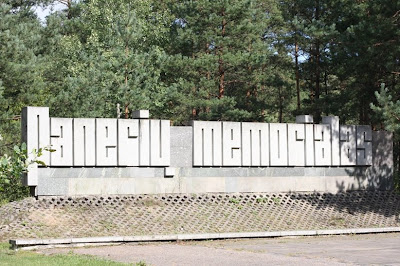 Entrance to Panieri Memorial
The landscape is dotted with stone monuments. One to Russian Jews. One to Polish Jews. One to Lithuanian Jews. There is a small museum but it wasn't open. I stick my camera lens through the grid of the gate to take a picture of the map on the wall. I can't see clearly what it is, but it looks like a map of Lithuania with icons to mark the killing fields.
We see a lady trundling by with a shopping bag on wheels. She looks like she's off to the market, as if she lives in the forests of Ponar and is off to the local Maxima supermarket. She looks incongruous with the landscape.
There is a lone grave. It is the only grave in this vast forest of pits and monuments and trees. One solitary grave to mark one person - Helinus Fegius (1888-1944). We are told that his family erected this tombstone in this doctor's honour. The rest, all 99,999 remain nameless and unmarked. They have to make do with stone monuments and wreaths to the collective.
 Solitary gravesite
Dan and Jesse have the camera out and the boom pole and they are trailing beside, behind and around Shiv and Chaim. I am still waiting for Vy to confirm when he can come today evening to set up the modem, and also to see if Andreas, a volunteer at The Green House, can still meet us for an interview later. I have kept my mobile on and I don't want the signal to interfere with the audio taping so I stay a fair bit away from where the action is; going close every now and then to catch Chaim's narration.
 Shiv looking pensive
I busy myself recording photos behind them. It will be a way for me to archive what we have seen and video-ed with the transcripts that will follow. I need visual cues. Besides, I know that Shiv eventually wants a record of places, things and people.
We follow along the paths and come to a circle of stones. It is the first pit. People were lined up around the rim and shot; their bodies falling into the pits and piled high on top of each other.
We walk along some more. The second and largest pit. I guess it is about 100 feet or so in diameter and about 15 feet deep. I imagine how many bodies can fit in here. I also wonder what it would be like to be alive and under 15 feet of bodies... I can't help but think these thoughts. And yet... when I look around me, it is strangely quiet and scenic. We walk further on, a third pit. Opposite, what resembles a pit, but we are told it is the escape pit, where prisoners created a tunnel using spoons...
 The largest pit at Ponar
I can hear the sound of a train passing by. Apart from that, all is quiet. I don't see or hear any birds. I only feel the cool breeze brush past me and over me; the sound of gentle rustling of trees. The forest is deep. I imagine what it must have been like to walk here, before there were paths, when it was all woods. I wonder how many trees are in this area. I fancy that each tree is a life that was taken, rebirthed. I wonder if there are 100,000 trees in this forest.
 How many trees are there?

The day passes quickly. We speed off to interview Andreas at The Green House. It is almost 4.30pm. We are tired. We return to the apartment. Dan downloads the day's footage and photos. I download the photos I have taken and start recording them. Still no internet. Vy sends me a text. He says he can only come at 10pm unless it is too late. I ask him to come. We all desperately want to check our emails. Besides, during the course of the day, it comes to me that it will be useful to journal my thoughts down. It will help me keep track of daily events. I have seen and heard so much in such a short space of time. If I don't record them, I will surely forget something. While waiting for Vy to arrive, I start archiving and scanning documents. I have taken 153 photos. I have to sort them to see what to keep, what to discard and how to keep track in a way that makes sense and will be easily retrievable. At 10pm, Vy shows up. By 10.30pm, we are able to get online. Thank goodness.


 Posts
Posts


