Wow, if I had to pick a word to describe the opening launch last night of the Surviving History: Portraits from Vilna exhibition in Vilnius, I would choose the word "overwhelming"....
Guests began to arrive 40 minutes ahead of the opening, sending us into a mini state of flux. Ieva, the head of the Tolerance Centre, was - like me - totally surprised - "20 minutes maybe, but 40 minutes?" she said to me, and we scrambled to bring out exhibition booklets and give the exhibition a last minute look over. But I digress...
Why was I overwhelmed? It was like a meeting of old friends. The narrators who had shared their stories with us, who were featured in the documentary as well as the exhibition, and here I have to name them - Berl Glazer, Cholem Sapsai, Fania Brantsovsky, Gita Geseleva, Isroel Galperin, Josef Levinson and Rachel Kostanian - greeted us and all who came with warmth, with open arms, and open hearts.
Those who were not there were sorely missed. Margarita Civuncik, who had passed away on the 23 June. Her daughter Luda came and the moment she saw the visual biography exhibit, filled with her mother's handwriting and poems, and images, and old photos... she just broke down. As I hugged her, I could feel her sadness and her pride, all mingled in her loss and longing.
Dora Pilianskiene, who is too frail to attend the event but her daughter Frida and son came and avidly checked out her photos and her visual biography exhibits. They were beaming.
Chasia Spanerflig, who is away on her annual holiday trip with her daughter...
Gita, who looked like a vision from heaven, she was shining - I can't describe it otherwise. When I greeted her, she hugged me tight and squeezed my hand and I could feel the love, the longing, the... I don't know what else. But I know it was a tremendous surge of energy. She looked at me, her eyes began to glisten and I started tearing... I had no words for her, as I speak neither Russian nor Lithuanian, so all I could do was repeat what I knew, "aciu" (thank you) and she said, "danke" in return.
Cholem, when he came through the door, gave us juicy kisses on the cheek and bear hugs. Who told me later, translated through Ruta of course, that he was pleased, that we had promised and had delivered. And who, of course, extracted from us the promise to drop by and visit when we next came.
Fania, with her ever-present smile, was as always, warm and enthusiastic and even played guide to the guests by showing them around the exhibits!
Rachel, who was effusive, and thanked us for the event, who has played such a big part in the project and who spoke at some events for us in the UK.
What can I say? But a very big and warm and grateful and sincere and loving 'thank you.' Thank you for your courage, thank you for your strength.
Because it certainly cannot be easy. To see your photos on the wall, to see your face adorning a piece of art, to see your life story interpreted subjectively by others, to see your face on screen, as we showed the Surviving History documentary. I think Isroel was a little overwhelmed by seeing himself on the screen of the auditorium. Perhaps he relived his pain; I watched out of the corner of my eye and felt really bad - he seemed a little distressed.
Josef was like a shining knight; he is a man of presence, nevermind his 90+ years. And you will see in the photos how he lit up the room.
Embassy officials were there to lend their support - from Poland, Russia, Japan, UK, Ireland, Germany, Hungary... Members of the Jewish community, some out of town visitors, and students who had trekked over from Vilnius University... H.E. Simon Butt, British ambassador to Lithuania, gave a lovely speech.
Polina Shepherd, who had flown in that day (she woke at 3am to get from Brighton to London Heathrow to catch her flight!) - God bless her! - put on a stirring and moving performance. I really loved the smile on Fania's face as she sang along and Isroel too.
Even Zara, the designer who has worked with us on this project, came too. And she was moved to tears and told me she was touched to be in the same place as the narrators whom she has come to know through the work - but until last night, from a distance.
Jesse covered the floor like a papparazzo, and caught the action from every angle - literally! Shivaun was beaming. What a night! What a night! A BIG thank you to all who came, about 150 in all, the students who filed in and filled the seats on the balcony, the ones who came early, the ones who came late, all who came and were a part of a special night. And especially to the wonderful people who made this project possible and the resulting exhibition and teachers seminar - the narrators, Ruta, Ieva, Ingrida, Jesse and Dan, and if I have missed out anyone, you know who you are :)
Below are slide shows of the photos from the event. Most of the photos are captioned but don't show up in the slideshow. So, if you wish to read the captions to these photos, you will have to go to our Flickr site to view these photo albums individually. (Links below)
Slide show 1
Created with Admarket's flickrSLiDR.
Slide show 2
Created with Admarket's flickrSLiDR.
To view the photos individually (and with captions)
---------------------------------------------------
Today was the first day of the Teachers Seminar. Shivaun is totally knocked out. For an insomniac, she has been asleep since 8.30pm! More on that in a future blog! (About the workshop, not Shivaun's insomnia :)
Showing posts with label Vilnius. Show all posts
Showing posts with label Vilnius. Show all posts
Friday, 11 September 2009


Saturday, 15 August 2009
All Roads Lead to Vilnius – 26 days and counting...
Okay, things are really hotting up now. We are manically preparing last minute work for the opening of the exhibition in Vilnius on the 10 September 2009. I’m still tearing my hair out trying to get the packing list in order. We have different suppliers involved, from flight cases to actual exhibit items, and trying to amass the necessary information on weights, dimensions and packaging is driving me a little crazy. I am wary that we will need to put together a comprehensive list for custom purposes as it may be necessary to get an ATA Carnet (kinda like a passport) for the exhibits, so I am – I admit – being a little anal with the details. Virgo that I am, I relish and abhor the activity at the same time :)
So anyways, a few days ago, we realized we had run out of time on one activity. For one of the exhibition sections – there are five sections in all (you can read about what the exhibition consists of here) – the Shoah Memorial, we have 200+ bottles that need to be labeled. Quite early on, the intention was to have everyone who had participated – the artists, the designers, the team members spread across several countries (you can read about the team members here) – to write these labels by hand. But alas, it has taken a while to get the list of names and finalize this installation. So unfortunately, we’ve had to only involve the immediate team.

Trying to be as neat as I can
As I was writing my share of the labels – the name of the massacre sites and the numbers killed at each location – that while I was rushing this task, I couldn’t help but be mindful of the poignant and sad significance of what I was doing. Each location isn’t just a location – it is a burial site. And the numbers I was trying to print in as neat a hand as possible were people, lives… And then there are those places where no one even knows how many were lost. I cannot help but imagine what it is like be erased as if one had not lived at all.
Throughout this project, at various stages, I have often felt overwhelmed by the material. No matter how many times I have seen, read or heard it. It happens without me realizing it – I could be reading an interview transcript again, or watching a video clip, or looking at the narrators’ photos. The feeling passes over me like a shadow, often fleeting. It dissipates eventually but I feel something akin to a residual, lingering emptiness; it settles gently into the pit of my stomach and stays there. If someone asks me the impact of this project on me, I think I will tell them – it is like a gentle sadness that lodges somewhere in my gut. I don’t know if that makes sense, but that’s how it feels.
Only 26 days to go now to the full exhibition opening in Vilnius. And about a week and half to have the items shipped. Again, as in the past, whenever we prepare to go to Vilnius, I am struck by mixed feelings of setting foot in that city once more.
So anyways, a few days ago, we realized we had run out of time on one activity. For one of the exhibition sections – there are five sections in all (you can read about what the exhibition consists of here) – the Shoah Memorial, we have 200+ bottles that need to be labeled. Quite early on, the intention was to have everyone who had participated – the artists, the designers, the team members spread across several countries (you can read about the team members here) – to write these labels by hand. But alas, it has taken a while to get the list of names and finalize this installation. So unfortunately, we’ve had to only involve the immediate team.

Trying to be as neat as I can
As I was writing my share of the labels – the name of the massacre sites and the numbers killed at each location – that while I was rushing this task, I couldn’t help but be mindful of the poignant and sad significance of what I was doing. Each location isn’t just a location – it is a burial site. And the numbers I was trying to print in as neat a hand as possible were people, lives… And then there are those places where no one even knows how many were lost. I cannot help but imagine what it is like be erased as if one had not lived at all.
Throughout this project, at various stages, I have often felt overwhelmed by the material. No matter how many times I have seen, read or heard it. It happens without me realizing it – I could be reading an interview transcript again, or watching a video clip, or looking at the narrators’ photos. The feeling passes over me like a shadow, often fleeting. It dissipates eventually but I feel something akin to a residual, lingering emptiness; it settles gently into the pit of my stomach and stays there. If someone asks me the impact of this project on me, I think I will tell them – it is like a gentle sadness that lodges somewhere in my gut. I don’t know if that makes sense, but that’s how it feels.
Only 26 days to go now to the full exhibition opening in Vilnius. And about a week and half to have the items shipped. Again, as in the past, whenever we prepare to go to Vilnius, I am struck by mixed feelings of setting foot in that city once more.
Tuesday, 4 August 2009
RIP: Margarita Civuncik, 23 June 2009
We received the sad news in late July that one of the survivors we had interviewed for this project, Margarita Civuncik, had passed away on 23 June 2009. Our condolences and prayers are with her family.
Margarita's life is a testimony to the courage of those who did not give in nor give up but found the strength and determination to persevere despite the odds.

Margarita was born Rita Tsives. She was the sixth child in a family of seven siblings. Together with the rest of her family, she was interned at Minsk ghetto and later forced into the streets during a pogrom, where convinced they would be killed, she escaped with her small daughter. She changed her name, forged identity documents, and fled, moving from village to village for the duration of the war, sometimes working, sometimes hiding, sometimes depending on the kindness of strangers. She found herself in Vilnius when the war ended and made it her home.
Her incredible experiences were recorded in her unpublished memoirs and the many poems she wrote for her children and grandchildren. Her family were her pride; she especially pointed out to us how they were a multicultural, multinational family - she told us: "The most important thing is to respect each other. It doesn’t matter what nationality a person is. I am against genocide. It is terrible… people against people. In my family, we are a mixture. We have become an international family, Lithuanian, Russian, Polish..."
We salute the amazing person Margarita was and the life she led. We are thankful for her generosity in telling us her story. The memories she shared, the gifts she gave us, her photos... these will be presented in the Surviving History: Portraits from Vilna exhibition, opening in Vilnius on 10th September 2009. We are honoured to have met Margarita, to be entrusted with passing on her experiences and the lessons she shared with us.
We salute an incredible woman, survivor, mother, grandmother.
Margarita's life is a testimony to the courage of those who did not give in nor give up but found the strength and determination to persevere despite the odds.

Margarita was born Rita Tsives. She was the sixth child in a family of seven siblings. Together with the rest of her family, she was interned at Minsk ghetto and later forced into the streets during a pogrom, where convinced they would be killed, she escaped with her small daughter. She changed her name, forged identity documents, and fled, moving from village to village for the duration of the war, sometimes working, sometimes hiding, sometimes depending on the kindness of strangers. She found herself in Vilnius when the war ended and made it her home.
Her incredible experiences were recorded in her unpublished memoirs and the many poems she wrote for her children and grandchildren. Her family were her pride; she especially pointed out to us how they were a multicultural, multinational family - she told us: "The most important thing is to respect each other. It doesn’t matter what nationality a person is. I am against genocide. It is terrible… people against people. In my family, we are a mixture. We have become an international family, Lithuanian, Russian, Polish..."
We salute the amazing person Margarita was and the life she led. We are thankful for her generosity in telling us her story. The memories she shared, the gifts she gave us, her photos... these will be presented in the Surviving History: Portraits from Vilna exhibition, opening in Vilnius on 10th September 2009. We are honoured to have met Margarita, to be entrusted with passing on her experiences and the lessons she shared with us.
We salute an incredible woman, survivor, mother, grandmother.
Saturday, 20 September 2008
Day 22: Countdown
It's about 10.30am now. About one hour to go before we hand over the keys to the apartment and head off to Cholem's to say goodbye and then, it's the airport. (See previous blog entry - the last time we met Cholem, he told us he wanted to send us off at the airport.) Apparently, Cholem fell down the day before at the cemetery. However, when Ruta called him yesterday, he still insisted on coming. But we suggested that it would be better if we just dropped by at his place on the way to the airport. Shiv has her gear ready now; we'll pop to the local cafe for some breakfast before Vy, the landlord, comes.
------------------------------------------------------------------------------------
12.00 nn. We meet Cholem at his flat. He is excited to see us. He meets us on the landing one floor before his flat and ushers us upstairs. As soon as we get through the door, I can see that he has coffee cups and a plate of biscuits on the dining table. Ruta and I make eyes at each other - we are thinking the same thing; how do we tell him that this is a flying visit and that we can't stay for too long as we have a flight to catch?

He tells us that he called the airport to check the flights. He was afraid he had missed us and that we had already left. Shiv tells him that we promised to drop by and here we are. He seems satisfied and trundles to and fro from the kitchen, boiling water, bringing out honey and jam he made himself. He wants us to eat.
Ruta tells him about our plans for the items he has given us and how we will exhibit it. He gets all animated and wants to share more; he goes to his cupboard and pulls out papers, cards; he digs through tins and containers... 'This one?' he motions, and passes them round for us to see, 'that one? Take, take, take."
 This one?
 Maybe that one?
 Huh? Cholem deliberates over his choices.
---------------------------------------------------------------------------------------
We take a few more photos. I like these two in particular (see below), because I think they capture how playful he is. In one photo, he looks a little cheeky, in the other he has an austere dignified pose.


----------------------------------------------------------------------------------
We tell Cholem we have to go. He wants to go too. In the van, on the way to the airport, he points out buildings and landmarks to us. 'This is the bank I deposited the money the German government gave us.' 'There is the hill where bodies were buried.' 'This is where blood was taken from children before they were killed.' He tells us all this in an assured manner, that of a man who has confronted his past and made peace with it.
At the airport, we say goodbye. The queues are long, so we suggest that Cholem and Ruta leave us there instead of waiting with us while we check in. Cholem seems a little disappointed. He thinks they should wait for 15 minutes, just to make sure that all is okay. We assure him that everything is alright. We hug him and he gives me a long peck on the cheek. We promise we will see him again the next time we come back to Lithuania. I don't know when that will be. But I know for certain that when we do, we will keep that promise.
------------------------------------------------------------------------------------
12.00 nn. We meet Cholem at his flat. He is excited to see us. He meets us on the landing one floor before his flat and ushers us upstairs. As soon as we get through the door, I can see that he has coffee cups and a plate of biscuits on the dining table. Ruta and I make eyes at each other - we are thinking the same thing; how do we tell him that this is a flying visit and that we can't stay for too long as we have a flight to catch?

He tells us that he called the airport to check the flights. He was afraid he had missed us and that we had already left. Shiv tells him that we promised to drop by and here we are. He seems satisfied and trundles to and fro from the kitchen, boiling water, bringing out honey and jam he made himself. He wants us to eat.
Ruta tells him about our plans for the items he has given us and how we will exhibit it. He gets all animated and wants to share more; he goes to his cupboard and pulls out papers, cards; he digs through tins and containers... 'This one?' he motions, and passes them round for us to see, 'that one? Take, take, take."
 This one?
 Maybe that one?
 Huh? Cholem deliberates over his choices.
---------------------------------------------------------------------------------------
We take a few more photos. I like these two in particular (see below), because I think they capture how playful he is. In one photo, he looks a little cheeky, in the other he has an austere dignified pose.


----------------------------------------------------------------------------------
We tell Cholem we have to go. He wants to go too. In the van, on the way to the airport, he points out buildings and landmarks to us. 'This is the bank I deposited the money the German government gave us.' 'There is the hill where bodies were buried.' 'This is where blood was taken from children before they were killed.' He tells us all this in an assured manner, that of a man who has confronted his past and made peace with it.
At the airport, we say goodbye. The queues are long, so we suggest that Cholem and Ruta leave us there instead of waiting with us while we check in. Cholem seems a little disappointed. He thinks they should wait for 15 minutes, just to make sure that all is okay. We assure him that everything is alright. We hug him and he gives me a long peck on the cheek. We promise we will see him again the next time we come back to Lithuania. I don't know when that will be. But I know for certain that when we do, we will keep that promise.
Tuesday, 2 September 2008
Day 6: AM

Candles from the Choral Synagogue
Tick tock. Tick tock. I am waiting for the time to pass. Very s-l-o-w-l-y. I busy myself tidying up the apartment and cleaning the coffee and dining table, wiping down the toilets, taking the garbage out... I take photos of the items we have collected for our archive, tag and record them, including some yamulke, candles and prayer book that Abraham gave us at the synagogue yesterday. I am waiting for 10am. This morning I did not go with the team to the synagogue to interview the Chief Rabbi. This is because I have to make an online payment to the landlord. He is not a happy man.

One of the yamulkes. The inscription reads: "Wedding of Arlene & Ronald. Dec 15, 1968. Kislev 24 5729. Ahayath Achim Synagogue. Atlanta Georgia." I wonder who is Arlene and Ronald, and I wonder if we will be able to trace them? I make a note to suggest this to Shiv.
Since Monday morning, we have been on the go till evening. I have not been able to do the online wire transfer to pay the balance on the apartment rent as there is only a window of time I can do it at between Monday to Friday. Our daily schedule is fluid and flexible. This is because our contact Ruta has a rough schedule of who we can meet and interview. We have a list of potentials we organised with her before we arrived. But because many of those we interview are frail and elderly, it is dependent on whether they are up to seeing us when we call. Also, we bump into people and new appointments are set up; or those we speak to are generous enough to suggest things to us or meet us again, and then, we reschedule and shift appointments around yet again.
Yesterday morning, I sent a text to Vy the landlord as we expected to finish earlier; so I kept him posted to let him know I expected to be able to get back on time to do the online payment. When we arrived back, I keyed in the payment details, but when I clicked 'pay', it sent me to a screen to say the service was unavailable. I looked at the time display on my laptop. It was 5.32pm UK time. I had missed the time by 2 minutes. At midnight, I turned on my mobile phone, which I had turned off for the day as it interferes with the audio recording. I had received 2 text from Vy asking about payment. I try to explain to him about the window of time but he sends me sarcastic texts back. He tells me the internet is 24 hours. Also asks me if I were in the UK, would I be allowed to stay in an apartment without paying. Shiv asks why he is so agitated; we paid a deposit didn't we? I tell her that I think J was just a broker. We paid the deposit to her.
This morning, I debate about enlisting Ruta's help to explain things to Vy. Also that we will be back by 3pm as we have an interview scheduled at the apartment for that time. So I should be able to effect payment then. However, after much deliberation, I decide against it. I tell Shiv that it is best I stay back and wait till the appropriate time to send payment and will join them at the second interview. I don't think Vy would care to hear about why he hasn't been paid.
It is now 9.34am local time. I have 26 minutes to go. I can't wait to pay Vy and strike this off my list of to-do's. I just want to focus on the job at hand and be a supportive team member in the process. That involves being on hand for the team, not waiting in an apartment for time to pass. But then again, I guess this is what a coordinator is supposed to do. Deal with irate landlords if need be.
Tick tock. Time passes slowly when you are waiting. I wonder if Berl feels this way each morning, waiting for his helper to arrive at the door and escort him to the synagogue?
----------------------------------------------------------------------------------
P/S: Below, photos I took at breakfast yesterday at Double Coffee. (I swear there are monopolies in this country where cafes and supermarkets are concerned. Double Coffee is a chain of cafes, kinda like Starbucks. They are everywhere. And Maxima is a chain of supermarkets. At every home we have gone to, I see Maxima plastic bags, no other brand...)

Jesse looking wistfully at his oatmeal porridge

Dan doesn't look impressed. He swears that his fruit salad had garlic in it.

Shiv listening intently to Ruta

Ruta on the phone, arranging yet another appointment
Dan took this photo of me. I am looking a little frazzled from wear. Plus puzzled as I keep forgetting which dials to adjust between aperture and exposure on the camera.

Sunday, 31 August 2008
Day 2: A Visit to Ponar/Panieri
This morning, we meet our guide Chaim. We decide to plan our day over breakfast in the old Jewish quarter. Chaim tells me his name is pronounced "Ha-im" with a strong inflection on the "h" like a cross between "k" and "h". It makes me think of the "(k)hreme cheese" joke that Shiv told me once, about the Jewish pronunciation of "c" which sounds more like "(k)h". He points to the Hebrew lettering on his cap and sweatshirt. He tells me it means 'guide.' (Later, I am told by Jess that it also means 'the learned one.')

Chaim
We decide to visit Ponar, also known as Panieri. It is the site of the memorial to the largest killing field in Lithuania. At The Green House yesterday, we saw a video clip of a survivor describing one of the pits there. The narrator was choking back tears when she described how she tried to scramble 'under' the Nazi guards, hoping to escape. She said, 'On left grandmother, on right aunt, when we were there, we were no longer father, grandmother,' something to that effect. I took it to mean that it was everyone to themselves at that point, at the precipice, on the brink of death. Shiv thinks she meant that they were all just bodies, nameless, without identities; pieces of meat...
We exit the restaurant. Out on the street, Chaim walks us up and down and points out places of interest. A passerby overhears us and she and Chaim exchange a few words. Chaim translates. She takes offense at his use of the word "Vilna" instead of "Vilnius." Later Chaim explains to us that to Jews, he uses the name Vilna; to others, he uses the Lithuanian name, Vilnius.

Chaim narrating on Stickliu Street
We arrive at Ponar, also known as Palnieri. I am a bit confused. The stone carving marking the entrance to the site is Panieru Memorialas. I can't tell what is Lithuanian, what's in Russian, or Polish. There are also Hebrew letterings.
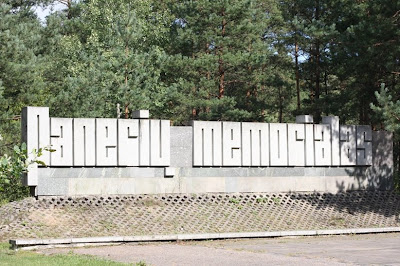
Entrance to Panieri Memorial
The landscape is dotted with stone monuments. One to Russian Jews. One to Polish Jews. One to Lithuanian Jews. There is a small museum but it wasn't open. I stick my camera lens through the grid of the gate to take a picture of the map on the wall. I can't see clearly what it is, but it looks like a map of Lithuania with icons to mark the killing fields.
We see a lady trundling by with a shopping bag on wheels. She looks like she's off to the market, as if she lives in the forests of Ponar and is off to the local Maxima supermarket. She looks incongruous with the landscape.
There is a lone grave. It is the only grave in this vast forest of pits and monuments and trees. One solitary grave to mark one person - Helinus Fegius (1888-1944). We are told that his family erected this tombstone in this doctor's honour. The rest, all 99,999 remain nameless and unmarked. They have to make do with stone monuments and wreaths to the collective.

Solitary gravesite
Dan and Jesse have the camera out and the boom pole and they are trailing beside, behind and around Shiv and Chaim. I am still waiting for Vy to confirm when he can come today evening to set up the modem, and also to see if Andreas, a volunteer at The Green House, can still meet us for an interview later. I have kept my mobile on and I don't want the signal to interfere with the audio taping so I stay a fair bit away from where the action is; going close every now and then to catch Chaim's narration.

Shiv looking pensive
I busy myself recording photos behind them. It will be a way for me to archive what we have seen and video-ed with the transcripts that will follow. I need visual cues. Besides, I know that Shiv eventually wants a record of places, things and people.
We follow along the paths and come to a circle of stones. It is the first pit. People were lined up around the rim and shot; their bodies falling into the pits and piled high on top of each other.
We walk along some more. The second and largest pit. I guess it is about 100 feet or so in diameter and about 15 feet deep. I imagine how many bodies can fit in here. I also wonder what it would be like to be alive and under 15 feet of bodies... I can't help but think these thoughts. And yet... when I look around me, it is strangely quiet and scenic. We walk further on, a third pit. Opposite, what resembles a pit, but we are told it is the escape pit, where prisoners created a tunnel using spoons...

The largest pit at Ponar
I can hear the sound of a train passing by. Apart from that, all is quiet. I don't see or hear any birds. I only feel the cool breeze brush past me and over me; the sound of gentle rustling of trees. The forest is deep. I imagine what it must have been like to walk here, before there were paths, when it was all woods. I wonder how many trees are in this area. I fancy that each tree is a life that was taken, rebirthed. I wonder if there are 100,000 trees in this forest.

How many trees are there?


The day passes quickly. We speed off to interview Andreas at The Green House. It is almost 4.30pm. We are tired. We return to the apartment. Dan downloads the day's footage and photos. I download the photos I have taken and start recording them. Still no internet. Vy sends me a text. He says he can only come at 10pm unless it is too late. I ask him to come. We all desperately want to check our emails. Besides, during the course of the day, it comes to me that it will be useful to journal my thoughts down. It will help me keep track of daily events. I have seen and heard so much in such a short space of time. If I don't record them, I will surely forget something. While waiting for Vy to arrive, I start archiving and scanning documents. I have taken 153 photos. I have to sort them to see what to keep, what to discard and how to keep track in a way that makes sense and will be easily retrievable. At 10pm, Vy shows up. By 10.30pm, we are able to get online. Thank goodness.

Chaim
We decide to visit Ponar, also known as Panieri. It is the site of the memorial to the largest killing field in Lithuania. At The Green House yesterday, we saw a video clip of a survivor describing one of the pits there. The narrator was choking back tears when she described how she tried to scramble 'under' the Nazi guards, hoping to escape. She said, 'On left grandmother, on right aunt, when we were there, we were no longer father, grandmother,' something to that effect. I took it to mean that it was everyone to themselves at that point, at the precipice, on the brink of death. Shiv thinks she meant that they were all just bodies, nameless, without identities; pieces of meat...
We exit the restaurant. Out on the street, Chaim walks us up and down and points out places of interest. A passerby overhears us and she and Chaim exchange a few words. Chaim translates. She takes offense at his use of the word "Vilna" instead of "Vilnius." Later Chaim explains to us that to Jews, he uses the name Vilna; to others, he uses the Lithuanian name, Vilnius.

Chaim narrating on Stickliu Street
We arrive at Ponar, also known as Palnieri. I am a bit confused. The stone carving marking the entrance to the site is Panieru Memorialas. I can't tell what is Lithuanian, what's in Russian, or Polish. There are also Hebrew letterings.

Entrance to Panieri Memorial
The landscape is dotted with stone monuments. One to Russian Jews. One to Polish Jews. One to Lithuanian Jews. There is a small museum but it wasn't open. I stick my camera lens through the grid of the gate to take a picture of the map on the wall. I can't see clearly what it is, but it looks like a map of Lithuania with icons to mark the killing fields.
We see a lady trundling by with a shopping bag on wheels. She looks like she's off to the market, as if she lives in the forests of Ponar and is off to the local Maxima supermarket. She looks incongruous with the landscape.
There is a lone grave. It is the only grave in this vast forest of pits and monuments and trees. One solitary grave to mark one person - Helinus Fegius (1888-1944). We are told that his family erected this tombstone in this doctor's honour. The rest, all 99,999 remain nameless and unmarked. They have to make do with stone monuments and wreaths to the collective.

Solitary gravesite
Dan and Jesse have the camera out and the boom pole and they are trailing beside, behind and around Shiv and Chaim. I am still waiting for Vy to confirm when he can come today evening to set up the modem, and also to see if Andreas, a volunteer at The Green House, can still meet us for an interview later. I have kept my mobile on and I don't want the signal to interfere with the audio taping so I stay a fair bit away from where the action is; going close every now and then to catch Chaim's narration.

Shiv looking pensive
I busy myself recording photos behind them. It will be a way for me to archive what we have seen and video-ed with the transcripts that will follow. I need visual cues. Besides, I know that Shiv eventually wants a record of places, things and people.
We follow along the paths and come to a circle of stones. It is the first pit. People were lined up around the rim and shot; their bodies falling into the pits and piled high on top of each other.
We walk along some more. The second and largest pit. I guess it is about 100 feet or so in diameter and about 15 feet deep. I imagine how many bodies can fit in here. I also wonder what it would be like to be alive and under 15 feet of bodies... I can't help but think these thoughts. And yet... when I look around me, it is strangely quiet and scenic. We walk further on, a third pit. Opposite, what resembles a pit, but we are told it is the escape pit, where prisoners created a tunnel using spoons...

The largest pit at Ponar
I can hear the sound of a train passing by. Apart from that, all is quiet. I don't see or hear any birds. I only feel the cool breeze brush past me and over me; the sound of gentle rustling of trees. The forest is deep. I imagine what it must have been like to walk here, before there were paths, when it was all woods. I wonder how many trees are in this area. I fancy that each tree is a life that was taken, rebirthed. I wonder if there are 100,000 trees in this forest.

How many trees are there?


The day passes quickly. We speed off to interview Andreas at The Green House. It is almost 4.30pm. We are tired. We return to the apartment. Dan downloads the day's footage and photos. I download the photos I have taken and start recording them. Still no internet. Vy sends me a text. He says he can only come at 10pm unless it is too late. I ask him to come. We all desperately want to check our emails. Besides, during the course of the day, it comes to me that it will be useful to journal my thoughts down. It will help me keep track of daily events. I have seen and heard so much in such a short space of time. If I don't record them, I will surely forget something. While waiting for Vy to arrive, I start archiving and scanning documents. I have taken 153 photos. I have to sort them to see what to keep, what to discard and how to keep track in a way that makes sense and will be easily retrievable. At 10pm, Vy shows up. By 10.30pm, we are able to get online. Thank goodness.
Arrival: A Recap
Today is already Day 4 in Vilnius, though technically speaking, it should be Day 3 seeing that we arrived late on Thursday, 28th August, at about 11pm.
The flight was delayed, leaving us stuck on board an Air Lithuania plane for about an hour before we finally taxied and took off. When we arrived, we are met by V, whom we had arranged our rental apartment with. He takes one look at our luggage - all 9 cases and a few hand luggage pieces and realises his car is not up to the task. We have 4 people in our team; Jesse and Dan, who will handle the camera and video; Shiv and I, who will deal with the interviews, archiving, collection of samples and audio transcripts. Really, it is my partner Shiv's project and part of her PhD research. I am playing the role of research coordinator. Jesse and Dan will be taking footage and shaping it into a documentary. We have 2 hard cases for the video and sound equipment, two long carrier bags for tripods and boom pole, plus a few other cases holding everything else including an audio recorder, laptops to a scanner, though we did decide to skip on the printer.
We decide to split up and grab a cab since V's car isn't big enough for us and our luggage. The cab driver doesn't look too pleased; he refuses to let us put one of our bags on the back seat. He motions with his hands; he doesn't want us to scratch the back of the seat. V comes over and shows his disapproval, helping the cab driver pile the bags high in the boot. It's all in. V tells the cabbie the address of the apartment we are going to. We get in; Dan and Jesse go with V. The cabbie veers off from the pavement and screeches away. For the first time in a very long time, I actually decide to put on my seatbelt, though I don't usually when I am in the back seat. His driving is nerve wracking to say the least. He doesn't smile and he doesn't seem to care for strangers. Similar to the people we passed at the airport; most don't smile and when they bumped into us, they didn't look up; they didn't make way either despite the overladen trolleys - I come to the conclusion that Lithuanians in general aren't particularly friendly. Then again, it's early days.
We are deposited in front of a building. It looks like an office block, with shops downstairs. Are we in the right place? There is no sign of V or the guys. A lady comes towards us and I realise it's J, whom we made the payment transfer to. We are joined by Vy, a skinny man with dusty blond hair. They ask us to follow them. Shiv and I drag 3 suitcases between us up to a heavy wooden door. Vy opens the door and I catch a glimpse of a long flight of wide stairs. I groan. Shiv's bag alone is 29 kgs. Thankfully, Vy helps lug one case up the stairs.
The apartment is sparsely furnished but clean. V and the guys join us 5 minutes later. They are huffing and puffing. They went up 3 flights of stairs, as did we. We give the apartment a once over to make sure we know where things are and what's in it - kitchen, bathroom, bedrooms, washing machine, etc. But no internet. Why? Okay, it appears there's a mix up of sorts. V is talking. Vy is talking. J is talking. All deep in animated conversation. I don't understand a word they say but I do know we specifically asked if there was internet access when we booked. J, who we paid the deposit to, is apologetic. So is V, whom we corresponded with and answered all our queries before we booked. Vy is anything but. There is talk about payment to Vy. Apparently, he is the landlord. He says to me haughtily, "I, no money, no internet." I try and explain that we were expecting to do an online bank transfer to pay the rental, but no internet, no money. He tells me he is too busy tomorrow to come and put in a modem. He suggests I go to an internet cafe and pay him first. I decide that I am too tired to haggle. I get straight to the point and tell him that we agreed to take the apartment because we were informed there was internet access. No internet, no money, I say sternly. He tells me he'll come tomorrow to fix it. Fingers crossed.

That night, we hunker down to discuss the brief for the project...
The flight was delayed, leaving us stuck on board an Air Lithuania plane for about an hour before we finally taxied and took off. When we arrived, we are met by V, whom we had arranged our rental apartment with. He takes one look at our luggage - all 9 cases and a few hand luggage pieces and realises his car is not up to the task. We have 4 people in our team; Jesse and Dan, who will handle the camera and video; Shiv and I, who will deal with the interviews, archiving, collection of samples and audio transcripts. Really, it is my partner Shiv's project and part of her PhD research. I am playing the role of research coordinator. Jesse and Dan will be taking footage and shaping it into a documentary. We have 2 hard cases for the video and sound equipment, two long carrier bags for tripods and boom pole, plus a few other cases holding everything else including an audio recorder, laptops to a scanner, though we did decide to skip on the printer.
We decide to split up and grab a cab since V's car isn't big enough for us and our luggage. The cab driver doesn't look too pleased; he refuses to let us put one of our bags on the back seat. He motions with his hands; he doesn't want us to scratch the back of the seat. V comes over and shows his disapproval, helping the cab driver pile the bags high in the boot. It's all in. V tells the cabbie the address of the apartment we are going to. We get in; Dan and Jesse go with V. The cabbie veers off from the pavement and screeches away. For the first time in a very long time, I actually decide to put on my seatbelt, though I don't usually when I am in the back seat. His driving is nerve wracking to say the least. He doesn't smile and he doesn't seem to care for strangers. Similar to the people we passed at the airport; most don't smile and when they bumped into us, they didn't look up; they didn't make way either despite the overladen trolleys - I come to the conclusion that Lithuanians in general aren't particularly friendly. Then again, it's early days.
We are deposited in front of a building. It looks like an office block, with shops downstairs. Are we in the right place? There is no sign of V or the guys. A lady comes towards us and I realise it's J, whom we made the payment transfer to. We are joined by Vy, a skinny man with dusty blond hair. They ask us to follow them. Shiv and I drag 3 suitcases between us up to a heavy wooden door. Vy opens the door and I catch a glimpse of a long flight of wide stairs. I groan. Shiv's bag alone is 29 kgs. Thankfully, Vy helps lug one case up the stairs.
The apartment is sparsely furnished but clean. V and the guys join us 5 minutes later. They are huffing and puffing. They went up 3 flights of stairs, as did we. We give the apartment a once over to make sure we know where things are and what's in it - kitchen, bathroom, bedrooms, washing machine, etc. But no internet. Why? Okay, it appears there's a mix up of sorts. V is talking. Vy is talking. J is talking. All deep in animated conversation. I don't understand a word they say but I do know we specifically asked if there was internet access when we booked. J, who we paid the deposit to, is apologetic. So is V, whom we corresponded with and answered all our queries before we booked. Vy is anything but. There is talk about payment to Vy. Apparently, he is the landlord. He says to me haughtily, "I, no money, no internet." I try and explain that we were expecting to do an online bank transfer to pay the rental, but no internet, no money. He tells me he is too busy tomorrow to come and put in a modem. He suggests I go to an internet cafe and pay him first. I decide that I am too tired to haggle. I get straight to the point and tell him that we agreed to take the apartment because we were informed there was internet access. No internet, no money, I say sternly. He tells me he'll come tomorrow to fix it. Fingers crossed.

That night, we hunker down to discuss the brief for the project...
Subscribe to:
Posts (Atom)

 Posts
Posts


